


Why Pet Water Gets Slimy: Causes and Cleaning
Table of Contents
- What Is the Slimy Film in Your Pet's Water Bowl?
- Understanding Biofilm in a Dog Water Bowl
- Factors That Make Pet Water Slimy Faster
- How to Clean a Slimy Pet Water Bowl
- How Often to Clean a Pet Water Fountain
- How to Prevent Slime in a Pet Water Fountain
- When to Seek Veterinary Advice
- Frequently Asked Questions
Last Updated: October 16, 2026
What Is the Slimy Film in Your Pet's Water Bowl?
That pet water slimy film coating your pet's water bowl is biofilm, a sticky layer of bacteria and microorganisms that builds up on surfaces.
Biofilm develops on any wet surface where bacteria settle and multiply, producing a coating that makes them harder to remove and kill.
The good news: regular cleaning prevents biofilm from reaching harmful levels.
Understanding Biofilm in a Dog Water Bowl
Biofilm forms predictably: free-floating bacteria encounter your bowl's surface, stick, then multiply and secrete a protective matrix of polysaccharides and proteins that holds the colony together.
This matrix is what you see and feel as slime.
How bacteria adhere and multiply
Bacteria are attracted to surfaces rather than sticking randomly. Once a few land, they release chemical signals that call more bacteria to join (quorum sensing), and within hours thousands form a coordinated community.
They then produce extracellular polymeric substances, a biological glue that anchors the colony and protects it from damage.
A thin, barely visible film can become a visible slimy coating in 48 to 72 hours under the right conditions.
Why standing water accelerates slime formation
Moving water inhibits biofilm growth: circulation disrupts colonies before they establish, brings fresh oxygen, and removes bacterial waste.
Standing water does the opposite, bacteria settle undisturbed, oxygen depletes, and waste accumulates, all favouring biofilm.
A bowl left unchanged for several days becomes an ideal biofilm incubator; a fountain that keeps water moving and fresh actively prevents it.

Factors That Make Pet Water Slimy Faster
Several conditions accelerate biofilm growth. Understanding them helps you predict when your pet's bowl needs cleaning.
Food particles, saliva, and debris
Every time your pet drinks, they introduce organic matter: saliva contains proteins and minerals bacteria feed on, food particles are nutrient-rich, and hair and dust add surface area for colonisation.
These materials don't just feed bacteria, they attract more of them, so a bowl with food residue develops biofilm faster than one with only clean water.
This is why bowls used for wet food develop slime more quickly than those used for water alone.
Temperature, sunlight, and water quality
Warm water accelerates bacterial reproduction. Bacteria multiply fastest between 20°C and 37°C. A bowl sitting in a warm kitchen or in direct sunlight creates ideal growing conditions.
Water quality also matters. Tap water's chlorine initially inhibits biofilm, but it dissipates quickly, especially in warm water or sunlight, after which bacteria colonise freely.
Stagnant water accumulates bacterial waste and becomes progressively more hospitable to biofilm; fresh water resists it longer.
How to Clean a Slimy Pet Water Bowl
Cleaning removes existing biofilm and slows its return. The routine below breaks the matrix with mechanical action, a surfactant, a sanitising step, and thorough drying, skip any one and the colony rebounds within a day or two.
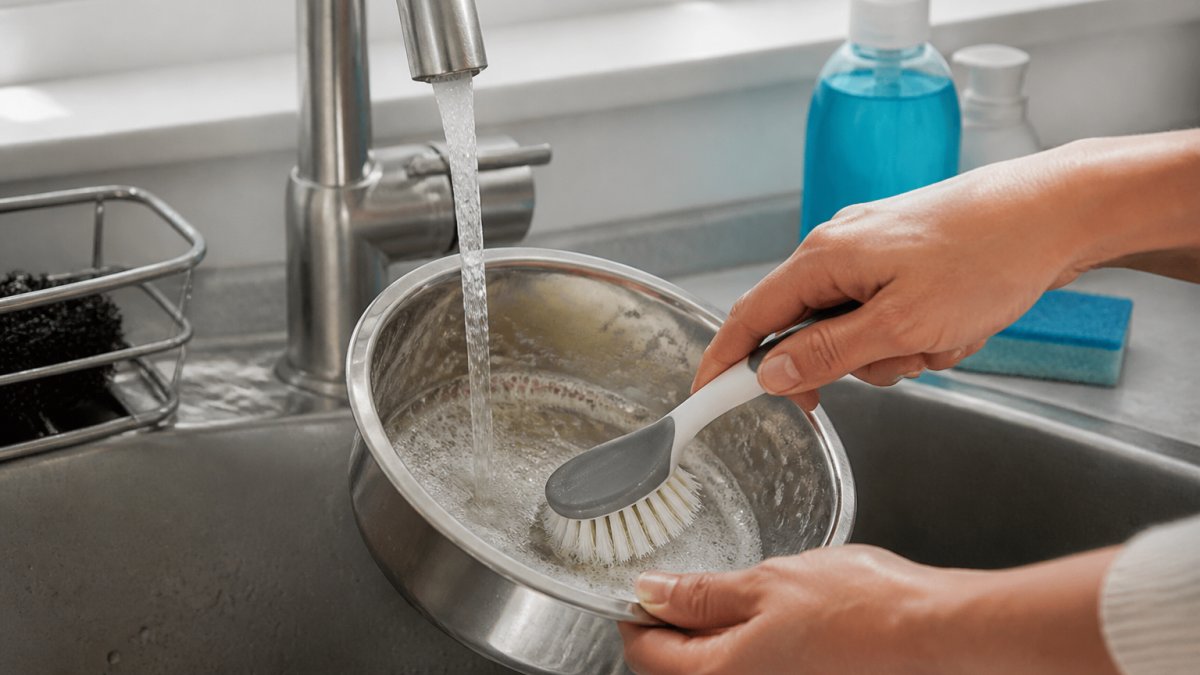
Daily rinsing and weekly deep cleaning
Daily care:
- Empty the bowl completely each morning and evening
- Rinse it thoroughly under running tap water, using your fingers or a soft sponge to wipe the entire inner surface
- Dry it with a clean cloth or leave it to air-dry upside down
This 30-second routine removes most biofilm before it becomes established. Drying matters more than most owners realise, biofilm survives far longer on a damp surface, so refilling a wet bowl gives surviving bacteria a head start.
Weekly deep clean:
- Empty the bowl and knock any loose debris into the bin.
- Wash with warm water and a mild, fragrance-free dish soap. Avoid antibacterial dish liquids, they leave residue that irritates a pet's mouth and don't penetrate biofilm any better than ordinary soap.
- Scrub every surface with a soft bottle brush or dedicated bowl brush, including the rim, underside, and any non-slip ring or base, hidden areas where biofilm survives between washes.
- Rinse under running water until the surface no longer feels slippery and no suds remain. Soap residue can put pets off drinking.
- Sanitise by soaking in a dilute white vinegar solution (roughly one part white vinegar to four parts water) for 10 minutes, then rinse again. Vinegar is pet-safe at this dilution and lifts mineral film soap leaves behind.
- Dry completely, air-dry upside down on a rack, or towel-dry with a cloth reserved for pet dishes only.
Pro Tip
Run two bowls in rotation. While one is drying, the other is in use. This removes the temptation to refill a damp bowl and gives the surface a full drying cycle between uses.
A soft brush works better than abrasive scrubbers on stainless steel, since harsh scrubbing creates microscopic scratches where bacteria hide. The same applies to plastic, once it feels rough or scratched, replace it.
Distinguishing biofilm from algae and mineral deposits
Not all slimy residue is biofilm, and treating the wrong problem wastes effort. Use this quick symptom guide before you reach for the soap.
| What you see and feel | Most likely cause | What to do |
|---|---|---|
| Clear or grey slippery film, forms within 1-3 days, present on all surfaces including shaded areas | Biofilm | Increase cleaning frequency; deep clean weekly |
| Green or brown tint, often on the sunlit side of the bowl, water looks cloudy | Algae | Move the bowl out of direct sunlight; scrub and rinse |
| White, chalky, rough or crusty ring, often at the waterline | Mineral deposits (hard water) | Soak in equal parts white vinegar and water for 30 minutes, then scrub gently |
| Slippery film that returns within hours of a wash, sometimes with a soapy smell | Detergent residue | Rinse more thoroughly; switch to a milder, fragrance-free soap |
| Pink, orange or rust-coloured patches | Pigmented bacteria or mineral staining | Deep clean; if it persists on stainless steel, check for pitting and replace |
Biofilm is the only one that feels genuinely slimy and slippery.
Green growth means direct sunlight, move the bowl to shade. White, crusty residue usually lifts with the vinegar soak above. Slimy residue that appears quickly is biofilm, clean more often and dry fully between refills.
VitalFlow™ Pet Fountain + 6 Filters Bundle →
Watch Out
Never mix vinegar with bleach-based cleaners. The combination releases chlorine gas, which is dangerous in a confined space such as a kitchen or laundry.
Safe cleaning products and what to avoid
Most owners reach for whatever is under the sink. A few of those choices are worth avoiding.
Safe for routine use:
- Mild, fragrance-free dish soap
- White vinegar diluted with water (for mineral film and light sanitising)
- Hot water and mechanical scrubbing
Use with care or avoid:
- Antibacterial and bleach-based sprays, effective on hard surfaces but easy to leave residue; if used, rinse exhaustively and air-dry before refilling
- Scented dish liquids and essential-oil cleaners, many essential oils are toxic to cats and small pets even in trace amounts
- Abrasive powders and steel wool, they scratch stainless steel and plastic, creating new biofilm-friendly crevices
Key Takeaway
The four-step rule: wash with soap, rinse until not slippery, sanitise with dilute vinegar, dry completely. Biofilm that survives all four steps is rare.
When to replace a bowl rather than clean it
Some bowls reach a point where cleaning no longer works. Replace the bowl if:
- The surface feels permanently rough or scratched, even after a deep clean
- Plastic has developed a persistent smell that survives washing
- Stainless steel shows pitting, rust spots, or a chalky film that vinegar will not lift
As a rough guide, plastic bowls used daily often need replacing every few months, while good-quality stainless steel or ceramic bowls can last years with proper care. Ceramic works well if the glaze is intact, once it crazes or chips, bacteria colonise the clay underneath and the bowl should be retired.
How Often to Clean a Pet Water Fountain
Fountains circulate water, which slows biofilm formation but does not stop it. Every surface the water touches is a potential colonisation site, and the parts you can't see are usually the dirtiest, a fountain that looks clean in the basin can still harbour thick biofilm inside the pump housing, impeller chamber, and tubing.
A realistic maintenance schedule
| Component | Frequency | What to do |
|---|---|---|
| Basin and drinking surface | Every 2-3 days | Empty, rinse, wipe with a soft sponge, refill with fresh water |
| Full disassembly clean | Weekly | Take the fountain apart and wash every removable part with mild soap and a bottle brush |
| Pump and impeller | Weekly | Open the pump housing, remove the impeller, rinse and scrub away slime and hair |
| Tubing and spouts | Weekly to fortnightly | Flush with warm water; use a narrow bottle brush if the tubing is wide enough |
| Reservoir (if separate) | Weekly | Wash as you would a bowl; do not just top it up |
| Filter | Every 2-4 weeks | Replace, not just rinse, see below |
| Full descale | Monthly | Soak removable parts in dilute white vinegar to lift mineral scale |
Cleaning the pump, impeller and tubing
The pump is the most overlooked part of any fountain and where biofilm tends to be thickest, since the warm, dark, slow-moving water inside is close to ideal growing conditions.
- Unplug the fountain before you touch anything. Water and live electrics do not mix.
- Disassemble the pump according to the manufacturer's instructions. Most pumps have a removable front cover and an impeller that lifts out.
- Rinse the impeller and its chamber under warm running water. Use a small brush, an old soft toothbrush works well, to clear slime, hair and grit from the impeller blades and the magnet well.
- Check the intake grille for hair and debris. A partially blocked intake reduces flow, letting biofilm establish in the slower-moving sections.
- Flush the tubing with warm water. If it's removable and wide enough, run a narrow bottle brush through it; if not, flush repeatedly until the water runs clear.
- Reassemble, fill with fresh water, and run the fountain for a minute before letting your pet drink, to flush any loosened debris.
Pro Tip
If the pump starts making a rattling or grinding noise, or the flow rate drops noticeably, the impeller is usually clogged or worn. Cleaning often restores it; if not, replacement impellers are inexpensive and far cheaper than a new fountain.
Filters: replace, do not just rinse
A filter in service for a few weeks isn't just ineffective, it becomes a biofilm reservoir. Trapped organic matter feeds bacterial growth, and once saturated, water passing through picks up more microbes than it removes.
- Replace carbon and ion-exchange filters every 2-4 weeks, or sooner in a multi-pet household or if the water starts to smell.
- Replace microporous or fabric filters when they discolour or the flow rate drops.
- Never rinse and reuse a filter beyond its stated life. Rinsing removes loose debris but leaves the biofilm and saturated media behind.
Preventing slime in a fountain between cleans
A few habits keep a fountain cleaner for longer:
- Change the water completely every 2-3 days rather than topping it up. Topping up concentrates waste products and nutrients.
- Keep the fountain out of direct sunlight and away from heat sources. Warmth accelerates bacterial growth.
- Rinse the basin daily with hot water, a 20-second rinse removes the early biofilm that would otherwise harden into a film.
Key Takeaway
If you only do one thing beyond the weekly wash, clean the pump. It is the part most owners never touch and the part most likely to be causing a persistent slimy feel or a musty smell.
A fountain unused for more than a few days should be drained, disassembled, cleaned, and refilled before your pet uses it again, biofilm that formed while idle won't clear itself once the pump restarts.
How to Prevent Slime in a Pet Water Fountain
Prevention is simpler than constant cleaning. A few smart choices reduce biofilm formation significantly.
Choosing materials and filtration systems
Stainless steel resists biofilm better than plastic: bacteria adhere less easily to smooth metal, while plastic develops microscopic scratches where they hide.
Filtration systems remove the particles bacteria feed on.
UV sterilisation destroys bacteria and microorganisms as water circulates, actively preventing biofilm formation rather than just slowing it. The VitalFlow™ Pet Fountain uses UV sterilisation alongside filtration to keep water cleaner.

Water circulation is crucial: continuous movement disrupts biofilm, while stagnant zones are where it thrives. Choose a fountain with strong, consistent circulation.
Keep the fountain in a cool location. Warmth accelerates bacterial growth, so a cool, shaded spot stays cleaner longer than direct sunlight or a spot near a heat source.
When to Seek Veterinary Advice
Most biofilm in a pet's water bowl is harmless. Regular cleaning prevents any real risk.
Contact your vet if:
- Your pet shows signs of illness after drinking from a visibly slimy bowl (vomiting, diarrhoea, lethargy)
- Your pet refuses to drink from fountains or bowls, even after cleaning
- Your pet has a history of urinary tract infections or other health issues and you want to optimise their hydration
A vet can advise whether your pet needs extra monitoring or whether a UV-sterilised fountain could support their wellbeing.
Most healthy pets are unaffected by normal biofilm levels.
Keeping your pet's water clean is one of the smallest choices that makes a real difference to their daily health.
Frequently Asked Questions
What causes pet water to get slimy?
Biofilm, a sticky layer of bacteria, fungi, and microorganisms, forms on surfaces where water sits. Bacteria adhere to the bowl's surface and multiply, especially in warm, stagnant water. Food particles, saliva, and debris trapped in the bowl accelerate this process. Even tap water contains planktonic bacteria that settle and accumulate over time, creating the visible slime film.
How often should I clean my pet's water fountain?
Rinse and refill your pet's water fountain daily. Clean the bowl thoroughly with hot water and dish soap at least twice weekly, scrubbing the surfaces where slime is most likely to accumulate. If you notice slime forming within a day or two, increase cleaning to every other day. Replace filters every 2-4 weeks depending on usage to maintain effective filtration and reduce bacterial growth.
How can I prevent slime in a pet water fountain?
Use a circulating water fountain with filtration and UV sterilisation to reduce stagnant water and microbial growth. Choose stainless steel over plastic, as bacteria adhere less readily to smooth metal surfaces. Keep the fountain out of direct sunlight, maintain cool water temperature, and replace filters regularly. Ensure fresh water is always available by refilling daily, and clean all surfaces weekly to interrupt biofilm formation.
Is the slimy film in my pet's water bowl harmful?
Biofilm itself can harbour harmful bacteria and fungi that may cause digestive upset or urinary tract issues, especially in pets with compromised immune systems. While most pets tolerate minor biofilm exposure, pets with recurring health issues or those prone to infections benefit significantly from cleaner water sources. If your pet shows signs of illness after drinking from a slimy bowl, consult your vet. Regular cleaning and filtration eliminate this risk.